
Get an independent UGA water test, not a sales pitch.
The most expensive water test in Georgia may be the one advertised as "free."
Typical "Free in-home water tests" end up being expensive not because the test itself costs anything, but because that "free test" typically becomes the opening act for an hours-long sales presentation and an $8,000–$10,000+ quote. That's why Honest Water Of Georgia exists - to provide a better way to get your family the clean water at every tap that you deserve. Have your water independently analyzed through the University of Georgia. Receive the results in writing. Understand what is actually in your water. Then decide what, if anything, you want to do about it with our Honest team.
Disclosure: Honest Water of Georgia is not affiliated with or endorsed by the University of Georgia. We recommend UGA because we believe the company selling your water-treatment system should not be the only source telling you what is in your water.
Watch first
Before you schedule a "free in-home water test," watch this.
A free water test is not automatically dishonest. But there's an important difference between a quick demonstration performed by someone trying to sell you equipment and an actual laboratory analysis performed independently of the sale.
In this video, the Honest Water Of Georgia team explains:
- Why and when Georgia homeowners should test their water
- Which UGA water test to request
- How much testing generally costs
- How to collect and submit the sample
- What common tests do, and do not, measure
- How Honest Water can help interpret the results
Why independent testing matters
The test is "free", because the sales appointment is the product.
Many in-home water tests are designed to demonstrate a few visible conditions such as hardness, chlorine or dissolved solids. Those measurements can be useful, but they are not the same as a comprehensive laboratory analysis, and they do not reveal every possible contaminant.
The bigger issue is the incentive. When the person testing your water also earns money by selling you a system, every result can become another reason to buy more equipment.
UGA also cautions that no single water test identifies every possible contaminant. Testing should be selected based on the water source, symptoms, local conditions and the homeowner's concerns.
- 1Test the water.
- 2Review the evidence.
- 3Determine whether treatment is needed.
- 4Choose the appropriate treatment.
- 5Compare systems and prices without pressure.
Independent testing puts YOU first:
Which UGA test should I request?
Start with the test that matches your water.
Homes on city or county water
Your water provider already performs extensive system-wide testing and publishes an annual Consumer Confidence Report. It's free and tells you about the water leaving the utility's system. You can also cross-check your utility's profile and contaminants detected through the EWG Tap Water Database . A home-specific test can still be useful for concerns at your own faucet. Community systems must provide the annual report by July 1.
Recommended starting point
- Read your utility's annual water-quality report.
- Request the UGA W2 Expanded Water Test for a home-specific treatment-design profile.
- Test chlorine immediately at the faucet with an onsite strip.
- Ask about lead, bacteria, PFAS, VOCs or other specialized testing when a concern exists.
UGA cannot perform a normal mailed-in free-chlorine analysis because chlorine must be measured within ~15 minutes of collection. Test chlorine onsite instead.
Homes on a private well
Private domestic wells are not routinely monitored like public water systems. The homeowner is responsible for testing and maintaining the water supply.
Recommended starting point
- W2 Expanded Water Test, initially and approximately every three years.
- W35 Total Coliform/E. coli, annually.
- W33C Private Well Chemical Test - ask your Extension agent whether this broader screening is appropriate.
The right combination depends on well age and condition, surrounding land use, household plumbing, and any symptoms you're experiencing.
Costs
What does UGA water testing cost?
Basic Water Test
Tests pH, calculated hardness and numerous minerals, including calcium, magnesium, iron, manganese, copper, sodium and zinc.
Best for
Basic mineral and hardness information.
Georgia Expanded Water Test
Includes W1 plus anions, soluble salts and alkalinity. Measures chloride, fluoride, nitrate, phosphate and sulfate. Identified by UGA as useful for water-treatment design.
Best for
Recommended when the purpose is designing treatment.
Our recommendation
Total Coliform and E. coli
Requires a special bottle and time-sensitive collection. Samples must reach the laboratory within 24 hours. Plus overnight delivery when applicable.
Best for
Recommended annually for private wells.
Private Well Chemical Test
Recommended by Georgia DPH for private wells approximately every three years. Includes the expanded profile plus lead and arsenic.
Best for
Broader chemical screen for private wells every ~3 years.
Pricing note: Your local Extension office may add shipping or handling charges. Always confirm the current total before collecting your sample. Published county totals vary because each office handles submission differently.
How to get tested
How to submit your water sample through UGA
- 1
Find your county Extension office
UGA operates through local Cooperative Extension offices throughout Georgia. Use the county-office locator or call 1-800-ASK-UGA1. The number routes to the Extension office associated with your phone's registered county.
- 2
Call before collecting anything
Tell the agent whether you're on city water or a private well, why you want the test, any taste/odor/staining concerns, and whether you're designing a treatment system. Ask: 'Would you recommend the W2 Expanded Water Test, and are there additional tests I should request?'
- 3
Get the correct container and instructions
UGA lists a 16-ounce plastic container for W2. Bacteria, radon and certain analyses require special containers. Your Extension office may supply the bottle or tell you what clean container is acceptable.
- 4
Collect the sample correctly
For many W1 and W2 household drinking-water samples, UGA recommends a first-draw cold-water sample after no water has been used for ~6–12 hours. The correct collection point depends on whether you're evaluating the well, the plumbing, or the water you actually drink. Follow your county agent's instructions.
- 5
Deliver the sample and pay the fee
Many county offices submit samples to the UGA laboratory on particular days. Time-sensitive bacteria samples usually require a special bottle and overnight delivery - don't collect one late in the week without confirming the lab can receive it in time.
- 6
Receive your written report
Turnaround varies. Many county offices quote 10–12 business days; others advise 2–3 weeks. When it arrives, review it with your county Extension agent, or send it to Honest Water for a second, treatment-focused explanation.
Or call 1-800-ASK-UGA1 to be routed to your county office.
Optional at-home screening
Want to check free chlorine at your faucet?
Chlorine levels change quickly after water leaves the faucet, which is why a normal mailed sample may not give a useful reading. These low-range free chlorine test strips give a simple approximation right at your tap.
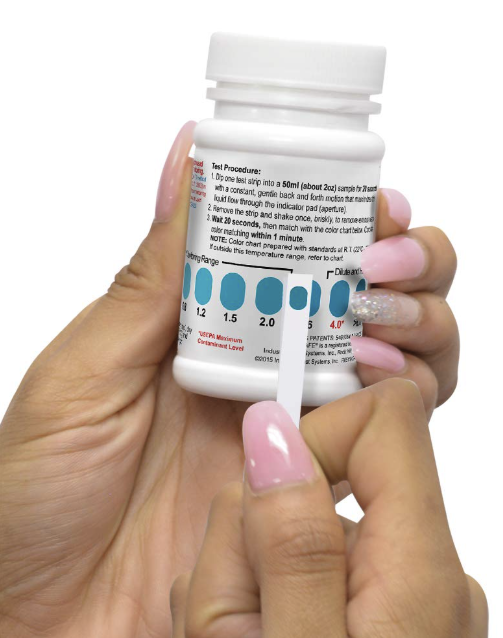
Paid affiliate link. Honest Water of Georgia may earn a commission from qualifying purchases at no additional cost to you. A low free-chlorine result does not necessarily mean that no disinfectant is present. Some public water systems use chloramine, which requires a different test. Review your utility's annual water-quality report or contact the utility to confirm which disinfectant it uses.
Already tested?
Already have your results? Let us translate them.
A laboratory report may contain dozens of numbers, abbreviations and recommended limits. We'll review yours and explain:
- Which results actually matter
- Which numbers are normal
- Whether you have a health concern, an aesthetic concern or both
- Whether the issue is coming from the well, utility, plumbing or water heater
- What type of treatment could address it
- What treatment would be unnecessary
- What an appropriately sized system should cost
There is no charge for the review and no obligation to purchase anything. Sometimes the right answer is a whole-home system. Sometimes it is a smaller drinking-water system, a well repair, a plumbing correction or no treatment at all.
We will tell you what we believe is right, even when the answer is not the most expensive option.
Get my free water report review
When treatment is needed, it should fit the water, not the sales commission.
Honest Water of Georgia designs treatment around the actual home, water source, household size and test results. Our most popular city-water system includes:
- Whole-home water softening
- Whole-home carbon filtration
- Under-sink reverse osmosis with remineralization
- Professional installation
- Premium, serviceable components
- Lifetime System Warranty
- Five-year valve warranty
Starting at just $3,492 installed.
No luxury markup. No mystery equipment. No three-hour kitchen-table presentation.
Just the right system, clearly explained, at an honest price.
FAQ
UGA water testing, answered
References
Official water-testing resources
- University of Georgia AESL water analyses
- UGA Cooperative Extension county-office locator
- Georgia Department of Public Health well-water guidance
- EPA Consumer Confidence Report information
- EWG Tap Water Database
Honest Water of Georgia is an independent water-treatment company and is not affiliated with, sponsored by or endorsed by the University of Georgia. Test availability, pricing, collection requirements and turnaround times may change. Confirm all details with your local Extension office before collecting a sample.