 Decaying leaves
Home & LivingAdvertisement
How Can North Georgia Tap Water Have Chemicals At Levels 376X Above Health Guidelines... Yet Still Be Completely “Legal” To Send Into Your Home?
And More Importantly - What Can You Actually Do To Protect Your Family?

By Grant Eilertson, Co-Founder of Honest Water of Georgia
Last Updated September 4, 2026·7 min read
Here's the strange part:
Your water company doesn't have to be doing anything wrong.
- No violation.
- No boil-water advisory.
- No failed inspection.
- No one secretly ignoring the rules.
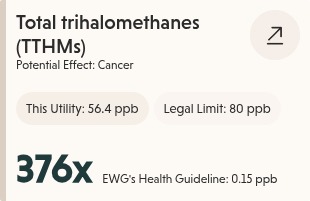
In fact, a North Georgia water system reported 56.4 ppb of total trihalomethanes in its water.
The federal legal limit?
80 ppb.
So by the standard the utility is legally required to meet, that water passes.
But EWG's health guideline for the same class of chemicals is just 0.15 ppb.
That means the detected level was...
EWG Health
Guideline
Guideline
0.15
ppb
Detected
56.4
ppb
Federal Legal
Limit
Limit
80
ppb
376X EWG's health guideline.
Still below the federal legal limit.
Still below the federal legal limit.
Total trihalomethanes, as reported to the EWG Tap Water Database.
And it was still below the federal limit.
Same water.
Same chemical.
Two radically different definitions of an “acceptable” number.
And almost nobody drinking that water knows there's a difference.
Before You Panic, There's Something Important You Should Know
This is not an article accusing North Georgia water departments of poisoning people.
Quite the opposite.
Your water utility has an incredibly difficult job.
They take water from lakes and reservoirs... kill dangerous bacteria... treat it... move it through miles and miles of underground pipe... and keep it disinfected until it reaches your house.
Without that process, modern cities simply wouldn't work.
The problem is what can happen along the way.
Because the chemical used to keep that water disinfected does not simply disappear when the water leaves the plant.
It keeps reacting.
And that reaction can create entirely new chemicals on the journey to your home.
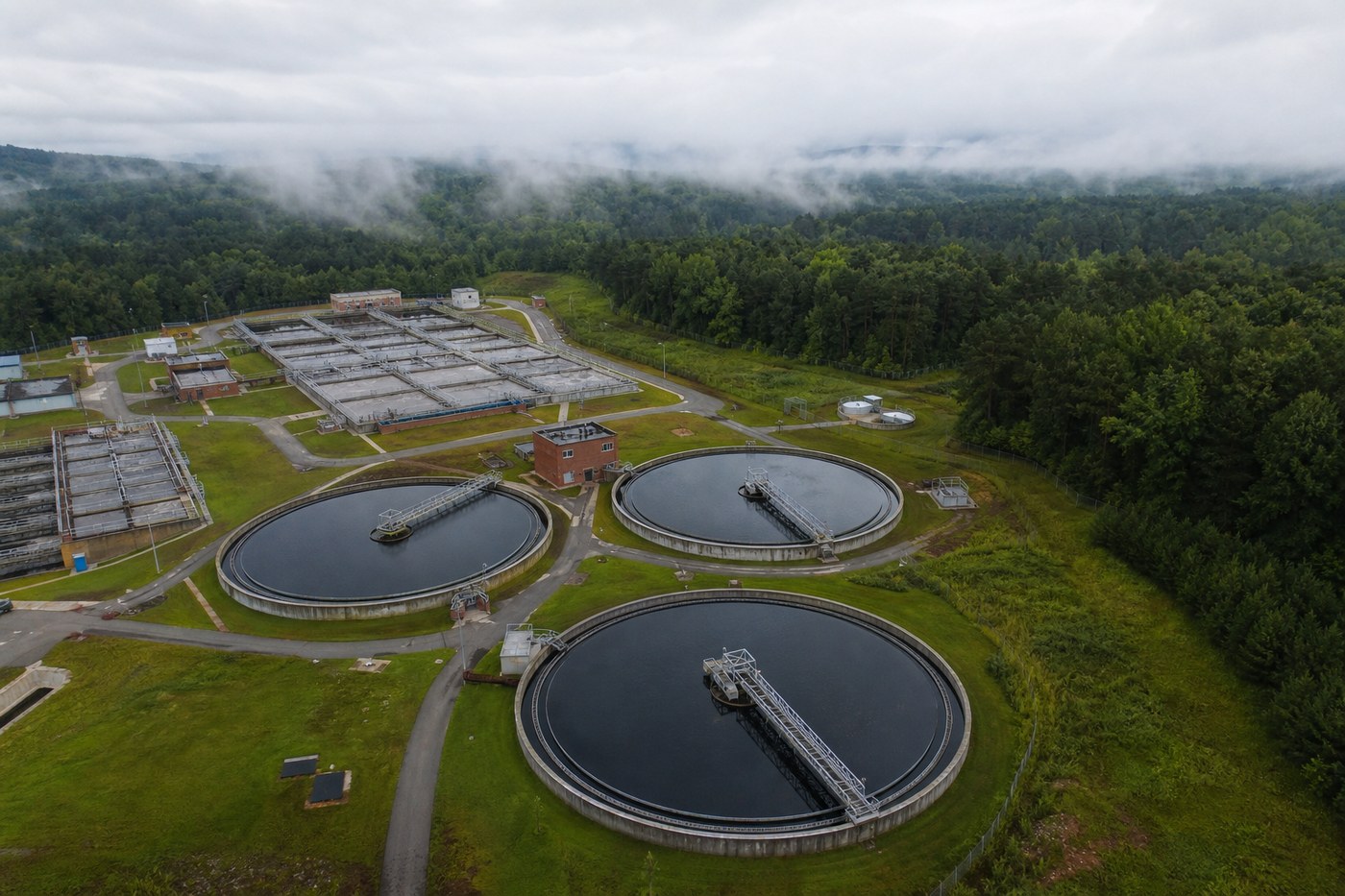
The system doing the workYour utility's job is to make water safe enough to travel. Not to control what happens after it leaves.
The journey of your water
North Georgia
reservoir
reservoir
▸
Treatment
plant
plant
▸
Miles of
distribution pipe
distribution pipe
▸
Your
neighborhood
neighborhood
▸
Your
home
home
Residual disinfectant continues reacting → disinfection byproducts can form
Illustration: how treated municipal water travels from the treatment plant to a North Georgia home.
Your Water Can Actually Create New Chemicals On The Way To Your Faucet
Most homeowners imagine water treatment like this:
Dirty water → treatment plant → clean water → your house.
Simple.
Except chemically, that isn't quite what happens.
North Georgia relies heavily on surface water from lakes and reservoirs.
And lake water naturally contains organic material:
- Leaves
- Algae
- Vegetation
- Sediment
- Runoff
Decaying leaves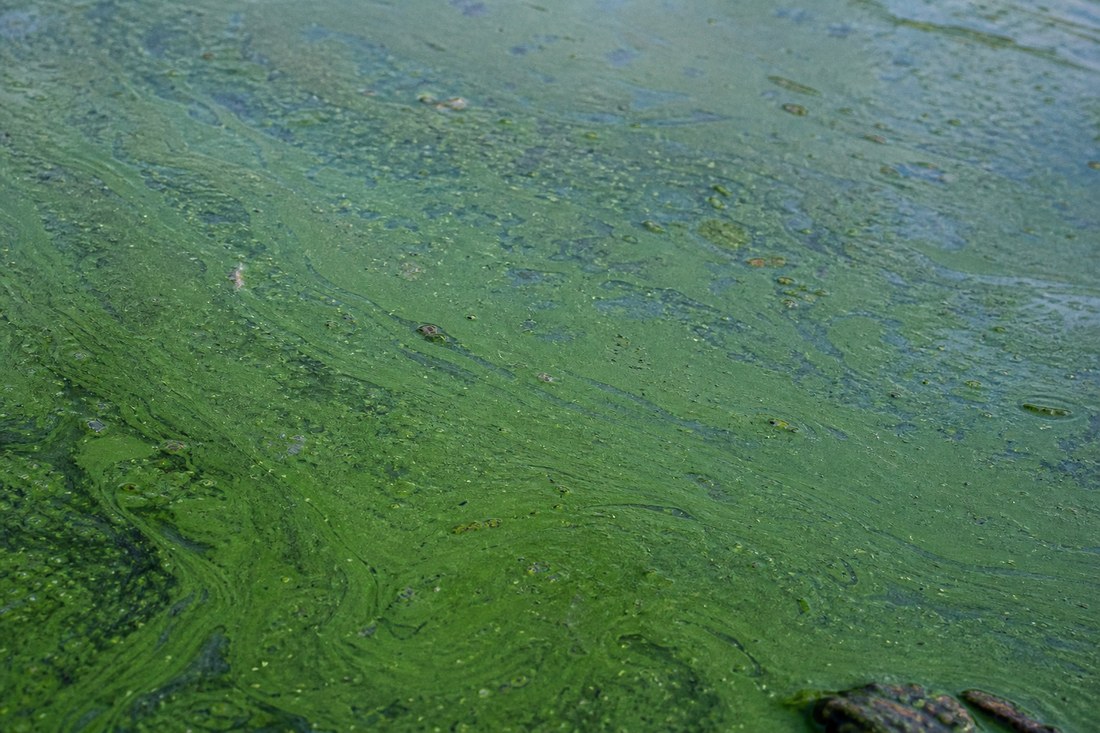 Algae bloom
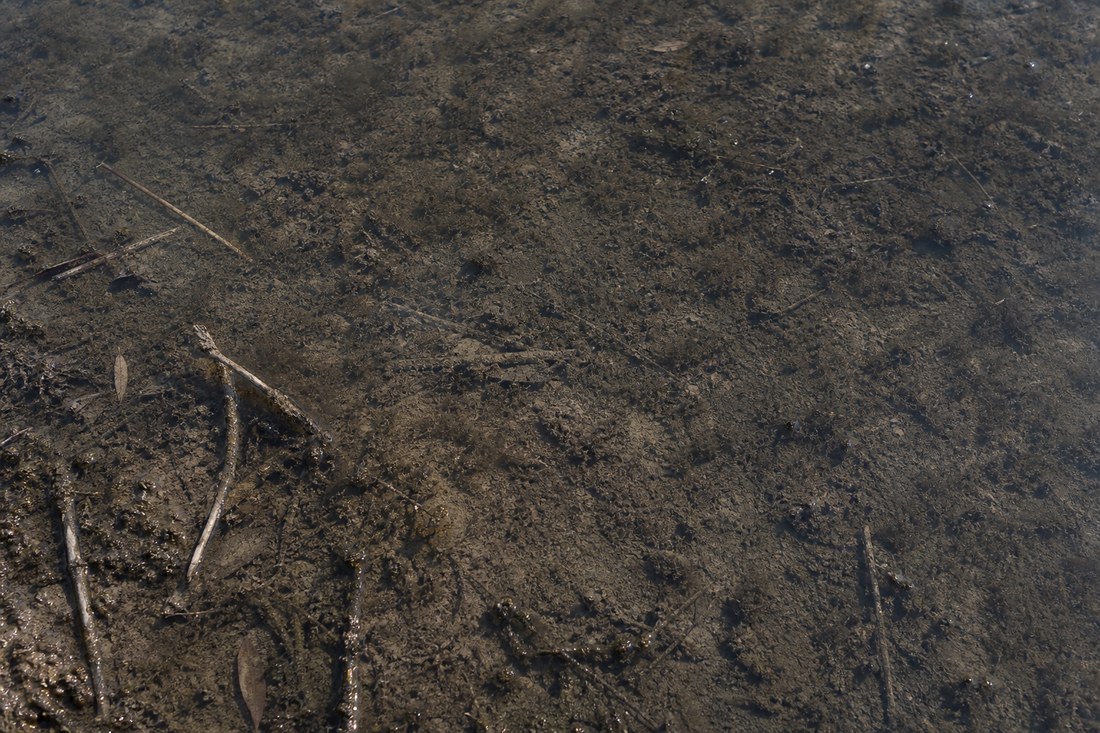 Sediment
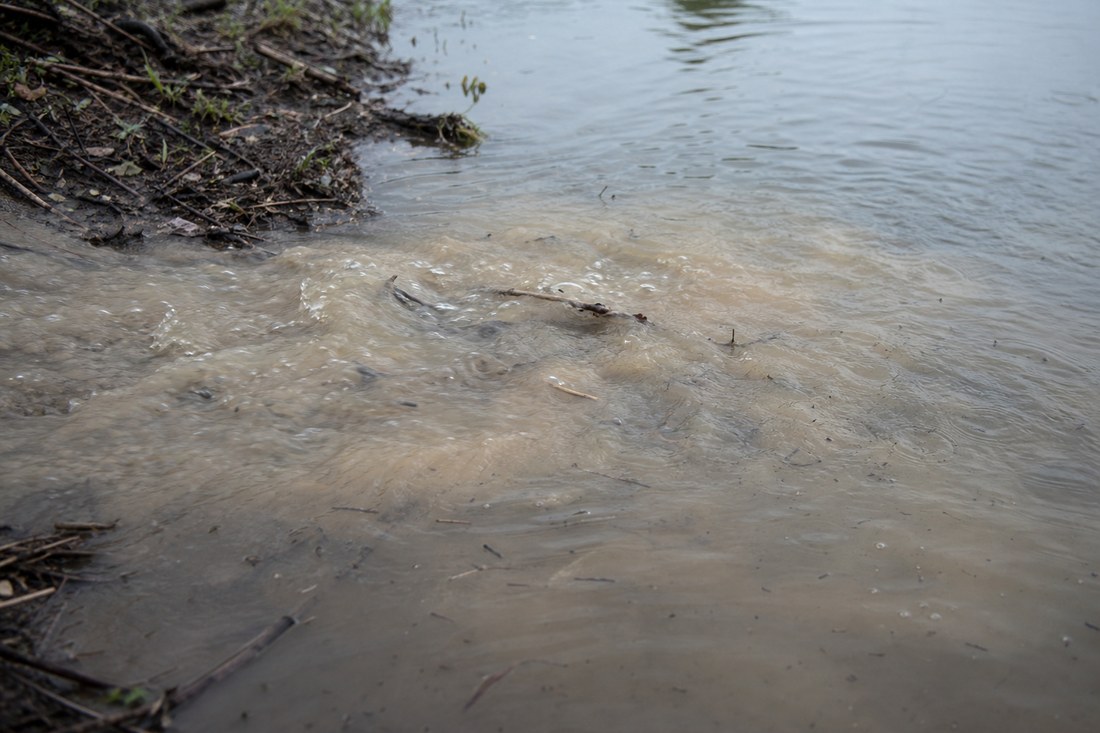 Runoff after rain
Completely normal stuff. It is also the reason your water has to be disinfected in the first place.
Utilities add disinfectants such as chlorine because killing dangerous microorganisms is absolutely necessary.
But chlorine is highly reactive.
When chlorine interacts with natural organic matter in water, it can form compounds known as disinfection byproducts.
How disinfection byproducts form
1
CHLORINE /
DISINFECTANT
DISINFECTANT
+
2
NATURAL ORGANIC
MATERIAL
MATERIAL
=
3
DISINFECTION
BYPRODUCTS
BYPRODUCTS
Two of the most common groups: Trihalomethanes (TTHMs) and Haloacetic Acids (HAAs)
Educational illustration. Not a depiction of an actual water sample.
That chemical reaction can continue while the water travels through the distribution system.
So “treated at the plant” does not necessarily mean the chemistry is frozen in time until it reaches your faucet.
The water continues traveling.
The disinfectant continues doing its job.
And reactions can continue occurring along the way.
Which Brings Us Back To That 376X Number
Take one North Georgia system serving communities around Jackson County.
According to EWG's Tap Water Database, its reported testing included total trihalomethanes at 56.4 ppb.
Same result. Two different report cards.
Federal legal standard
56.4 ppb detected
80 ppb legal limit
80 ppb legal limit
PASS
Below the legal limit.
EWG health guideline
56.4 ppb detected
0.15 ppb health guideline
0.15 ppb health guideline
376X ABOVE
Well above the guideline.
EWG is an independent nonprofit. Its health guidelines are not federal legal limits, and a utility is not required to meet them.
Same compound. Same reported concentration. Two radically different benchmarks.
And that's not the only number that jumps off the page.
EWG identifies multiple contaminants detected in this water system above its health guidelines. Some by dozens of times. Some by hundreds.
And for several individual compounds listed in the database... there is no individual federal legal limit at all.
See all 11 contaminants EWG lists above its health guidelines
| Contaminant | Detected | vs guideline |
|---|---|---|
| Haloacetic acids (HAA9) No legal limit | 39.6 ppb guideline 0.06 ppb | 659x |
| Total trihalomethanes (TTHMs) Legal limit: 80 ppb | 56.4 ppb guideline 0.15 ppb | 376x |
| Haloacetic acids (HAA5) Legal limit: 60 ppb | 35.3 ppb guideline 0.1 ppb | 353x |
| Trichloroacetic acid No legal limit | 19.1 ppb guideline 0.1 ppb | 191x |
| Chloroform No legal limit | 46.2 ppb guideline 0.4 ppb | 115x |
| Bromodichloromethane No legal limit | 5.33 ppb guideline 0.06 ppb | 89x |
| Dichloroacetic acid No legal limit | 16.1 ppb guideline 0.2 ppb | 81x |
| Dibromochloromethane No legal limit | 3.52 ppb guideline 0.1 ppb | 35x |
| Uranium Legal limit: 20 pCi/L | 7.11 pCi/L guideline 0.43 pCi/L | 17x |
| Nitrate and nitrite Legal limit: 10 ppm | 1.09 ppm guideline 0.14 ppm | 7.8x |
| Chromium (hexavalent) No legal limit | 0.0916 ppb guideline 0.02 ppb | 4.6x |
Source: EWG Tap Water Database, utility-reported results 2021-2023. Every entry above is listed by EWG with potential effect: cancer. EWG health guidelines are independent benchmarks, not legal limits.
Think about what that means.
“Compliant” does not necessarily mean nothing undesirable was detected.
It means the water complied with the regulations that currently exist.
Those are two very different statements.
And That's Why Your Water Company Can Be Doing Everything Right
This distinction matters.
Because fear-based water companies love pretending your local utility is the bad guy.
We don't think that's honest.
Jackson County isn't secretly ignoring federal standards. Neither are Gwinnett, Hall, Forsyth, or the other utilities serving North Georgia.
They're operating huge public water systems and following the rules they're given.
The legal standard and the standard you personally want for your family may not be the same thing.
You might look at 56.4 versus 80 and say: “Great. It passes.”
Someone else might look at 56.4 versus 0.15 and say: “Why would I want that coming into my house if I can reduce it?”
Neither response requires a conspiracy.
It just requires knowing the numbers exist.
And In North Georgia, There's Another Water Story Worth Knowing
Disinfection byproducts are at least something utilities test for.
But not everything that can end up in source water has historically been regulated or routinely measured.
PFAS is a perfect example. For decades, PFAS compounds were widely used in products including stain-resistant carpeting and textiles, and North Georgia has an especially interesting history here, because Dalton became one of the largest carpet-manufacturing centers in the world.
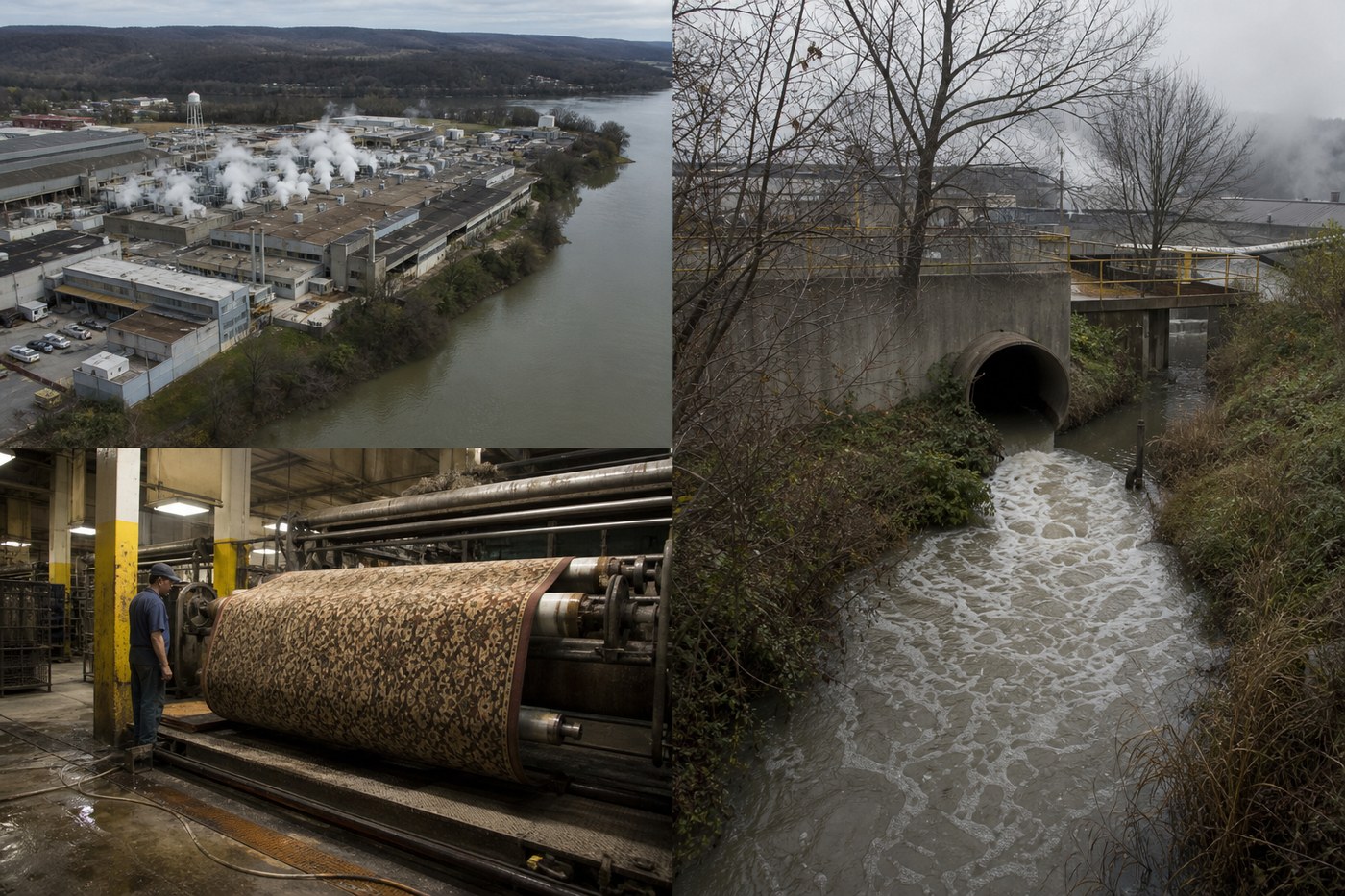
IllustrationDalton became one of the largest carpet manufacturing centers in the world.
Illustration of textile manufacturing and industrial discharge. Not a photograph of a specific facility.
Only recently did federal drinking-water limits begin catching up with several PFAS compounds.
Does that mean your specific faucet contains dangerous levels of PFAS?
We have no idea without testing it. And anyone who tells you otherwise is selling fear.
But it changed the question we were asking.
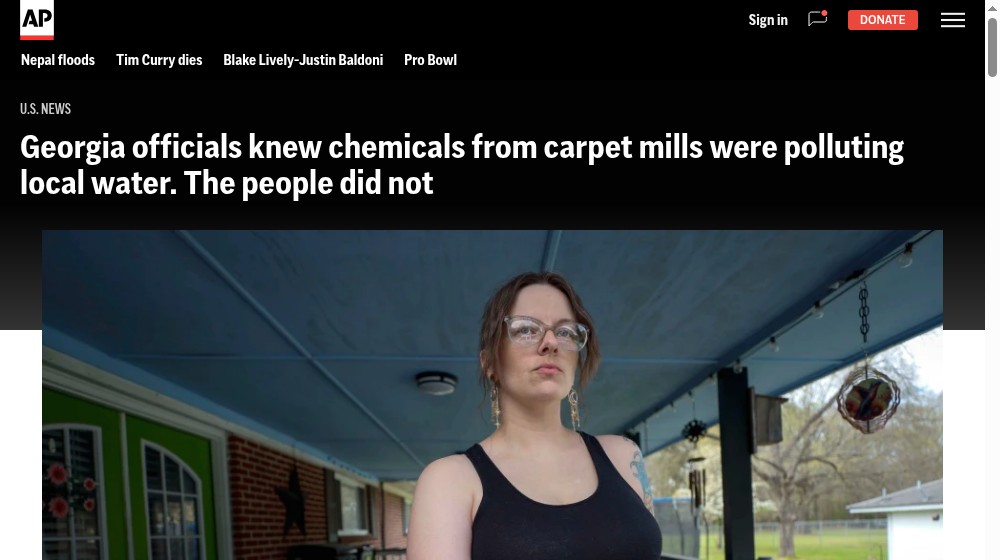
Associated Press, with the Atlanta Journal-Constitution and FRONTLINE Read it →
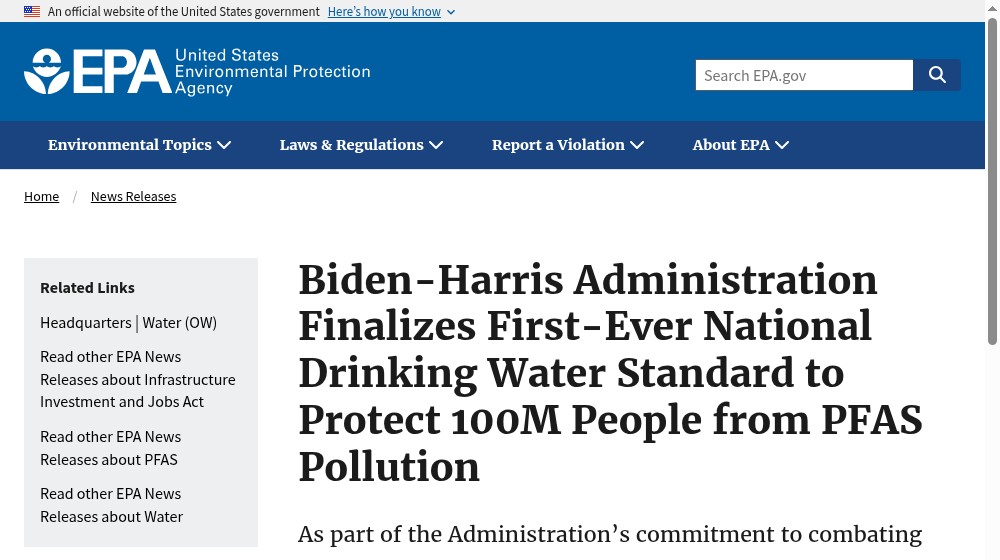
U.S. Environmental Protection Agency, April 2024 Read it →
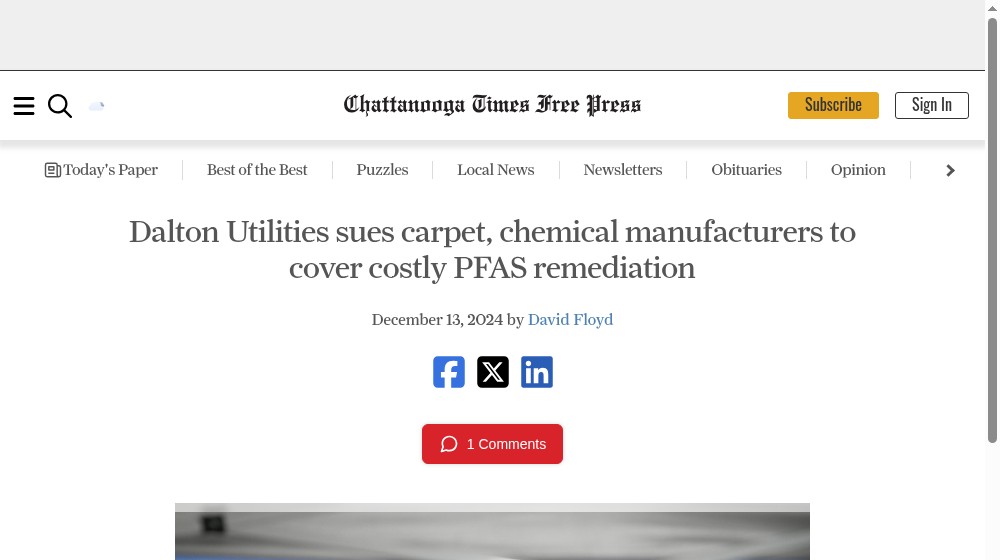
Chattanooga Times Free Press, December 2024 Read it →
We are not the ones reporting this. Those are the sources. Read them yourself.
Instead of: “Does my water company say my water passes?”
We started asking: what do we personally want coming into our home every day?
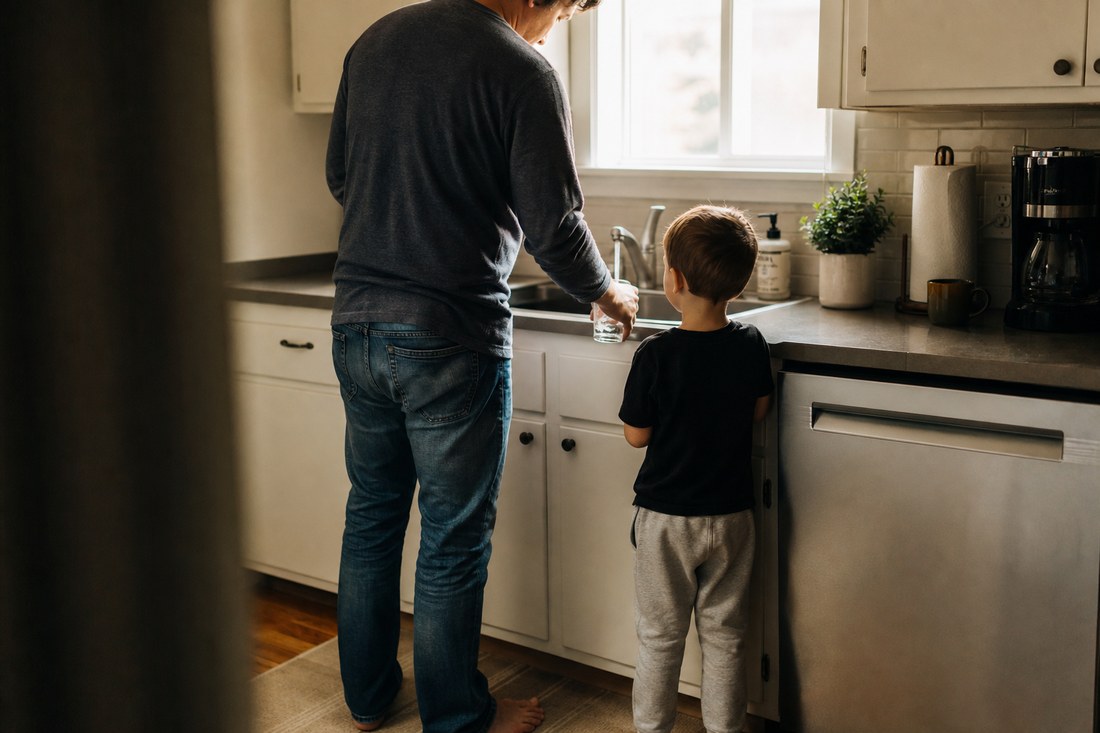 The glass you hand your kid
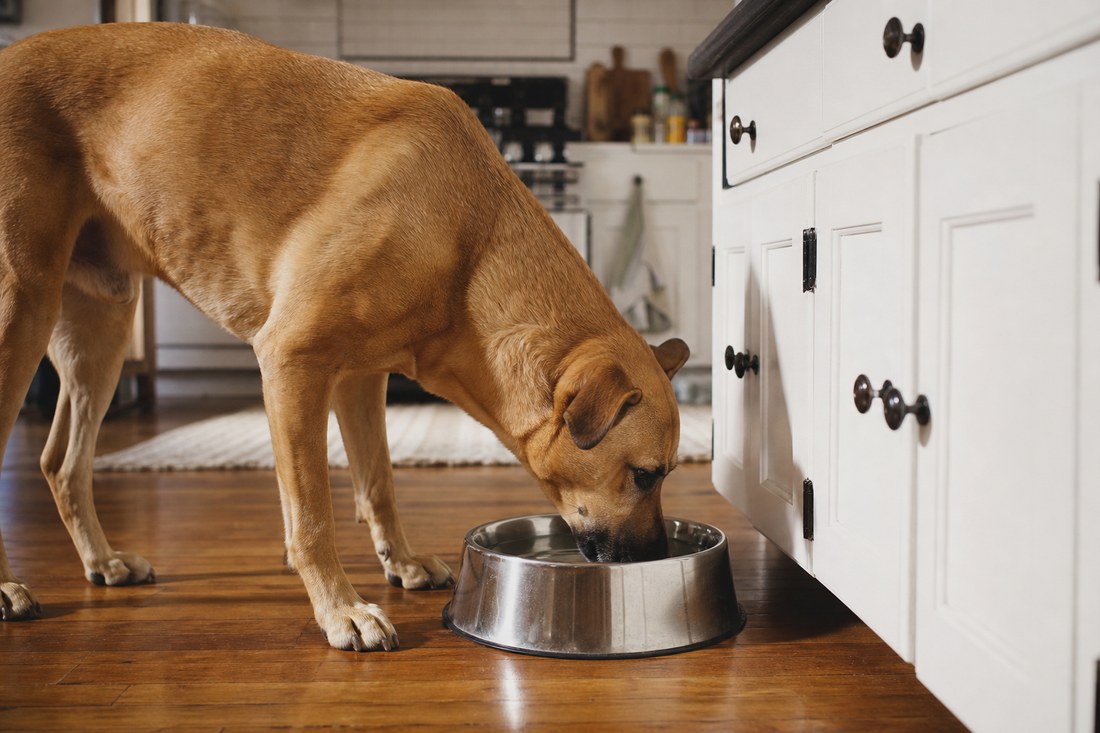 The bowl on the floor
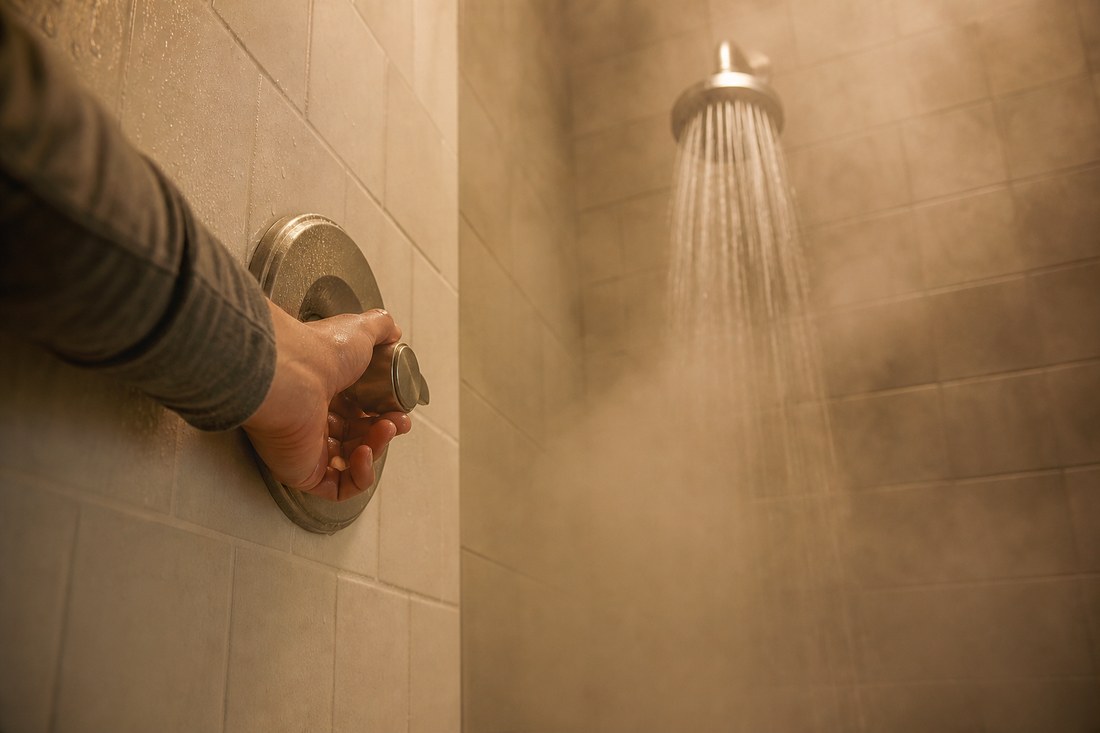 The shower you stand in every morning
 The water you rinse dinner in
Because those aren't necessarily the same question.
Then We Realized Something Else: You Barely Drink Most Of The Water Your House Uses
Most people who become concerned about their water make the same first move: they filter the kitchen sink. Or buy bottled water.
That makes intuitive sense. After all, that's the water you drink.
Except drinking is only a tiny fraction of the water your house actually uses.
Think about a normal day. You wake up and shower in it. Brush your teeth with it. Make coffee with it. Wash your hands in it. Cook pasta in it. Wash produce in it. Fill the dog's bowl with it. Wash your clothes in it. Run your dishwasher with it. Bathe your kids in it.
Then do the same thing again tomorrow. And the next day.
 Every shower
 Every bath
 Every pot of coffee
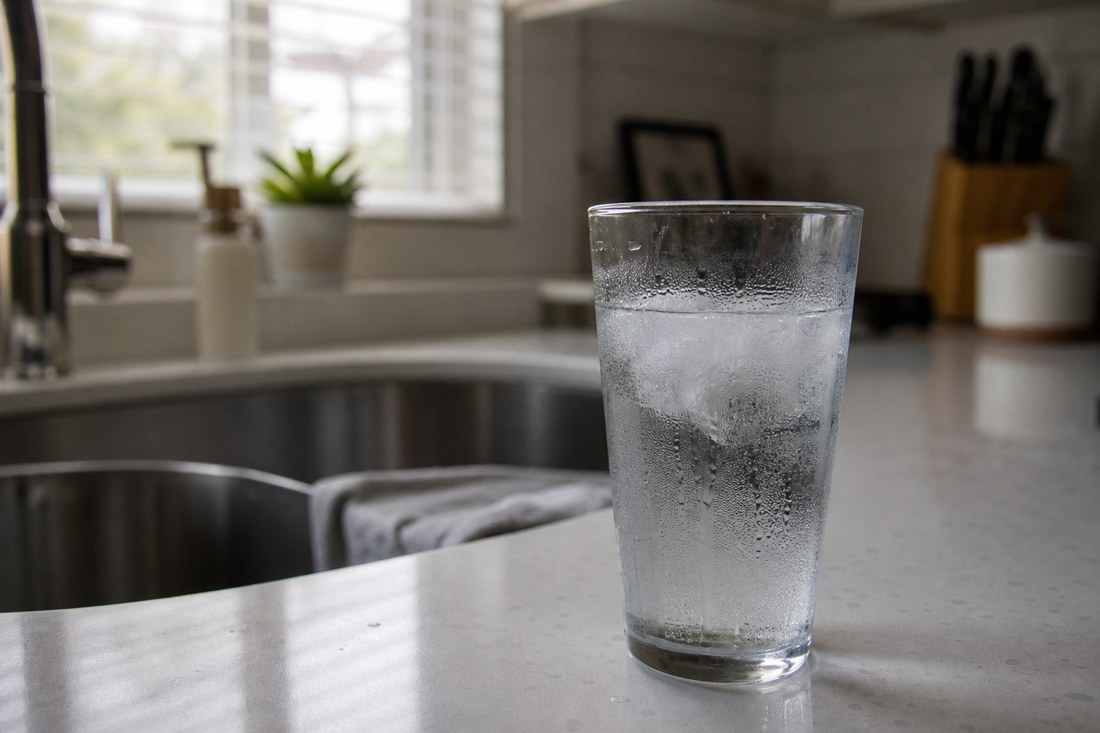 Every glass and ice cube
Where your household water actually goes
Shower
Bath
Laundry
Dishwasher
Cooking
Cleaning
Bathroom sinks
Drinking
A typical household can use hundreds of gallons of water every single day. Filtering one faucet changes the highlighted square only.
So once we started thinking about water this way, something became obvious:
Filtering one little faucet didn't make much sense anymore.
Because most “water filters” only fix about 1% of the problem
A pitcher? Great for the water you pour into it. But your shower doesn't run through your pitcher. Neither does your washing machine. Your dishwasher. Your bathroom sinks. Your water heater. Or the hose you use to fill the dog's bowl.
A refrigerator filter? Same problem. One appliance.
A shower filter? Now you've covered one shower.
A countertop RO? Excellent drinking water. Still one faucet.
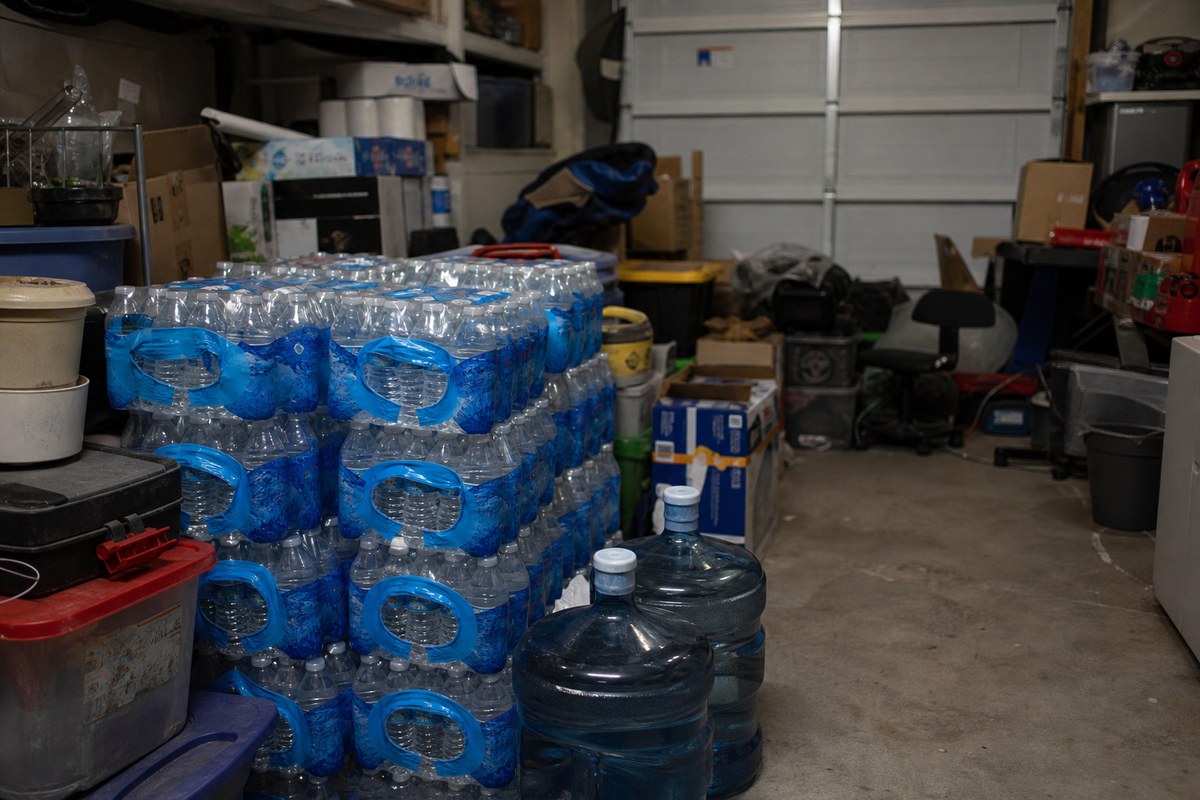
Bottled water? You can spend hundreds of dollars every year carrying cases into a house that's already connected to a water supply... and still shower, cook and wash everything else in unfiltered tap water.
And here is the part almost nobody adds up.
Most families aren't paying nothing. They're already paying, a little at a time, in six different places.
So let's look at what that patchwork actually costs.
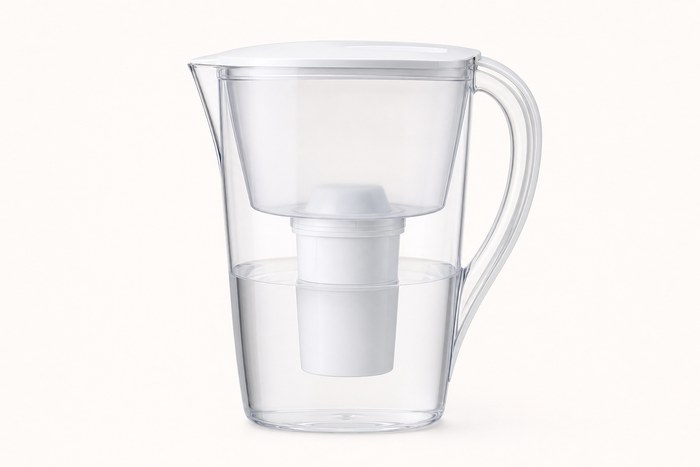
Pitcher filter
~$40per year in cartridges
Covers what you pour into it
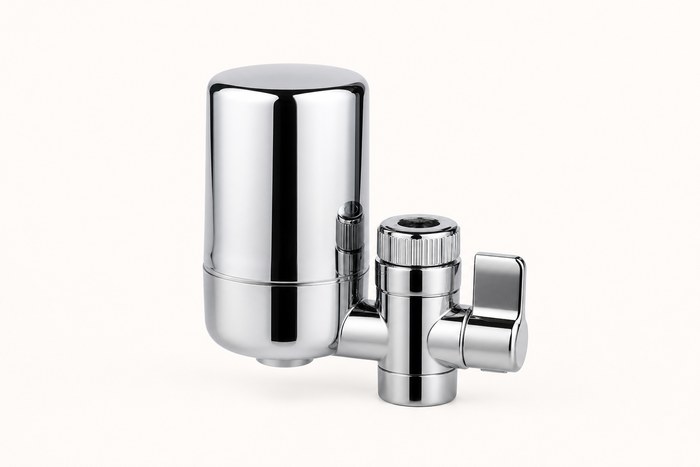
Faucet filter
~$80per year in cartridges
Covers one kitchen tap
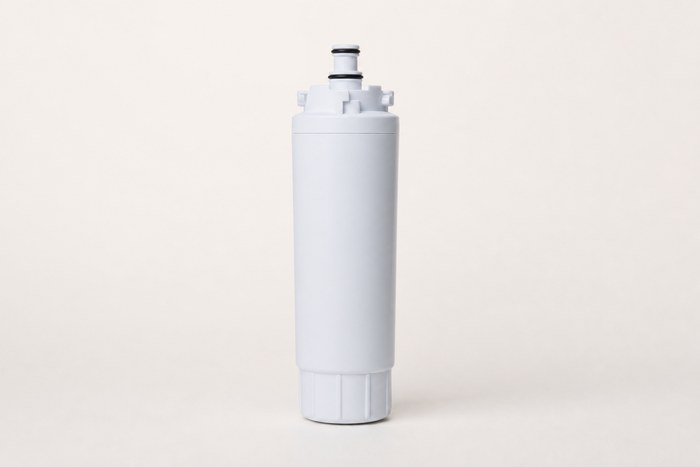
Refrigerator filter
~$100per year in cartridges
Covers one appliance
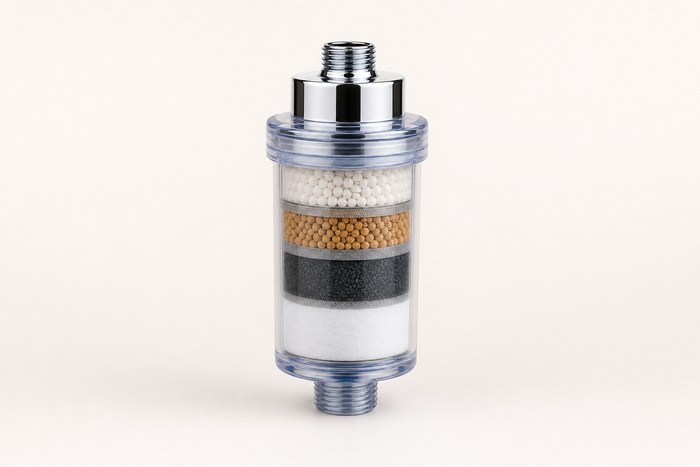
Shower filter
~$250per year, two showers
Covers two shower heads
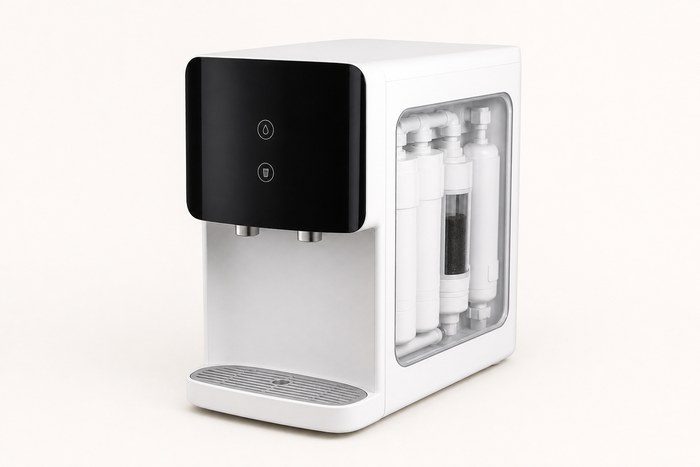
Countertop RO
~$360up front, then filters
Covers one faucet
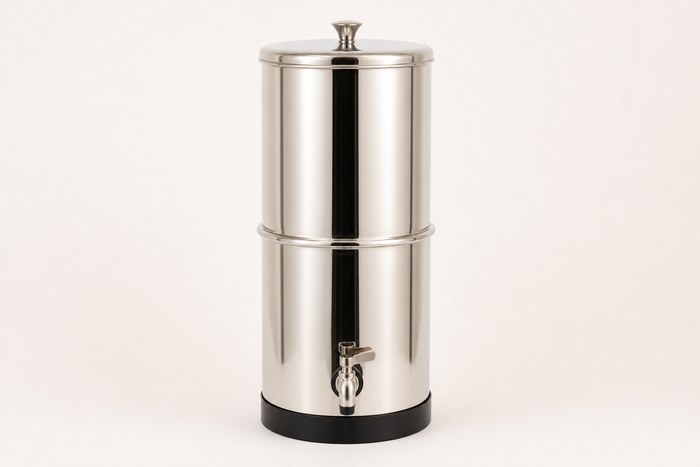
Gravity filter
~$470up front, then filters
Covers one countertop
Approximate retail costs for mid and upper tier consumer products, based on current manufacturer list prices and published replacement schedules.
The cost of doing nothing
Patching the basics: two shower filters, fridge filter, pitcher~$390 / yr
Adding a countertop RO for drinking water~$420 / yr
Gravity filter with fluoride cartridges, plus shower filters~$485 / yr
Delivered five gallon water, premium shower heads, fridge filter~$2,060 / yr
Every one of those numbers repeats. Every single year.
And in every one of them, most of the water in the house is still untreated.
And in every one of them, most of the water in the house is still untreated.
Once you see the problem as the water entering the house, the solution starts looking different.
So We Asked A Different Question: What If You Treated The Water Before Your House Ever Got A Chance To Use It?
That's the basic idea behind whole-home filtration.
Instead of chasing water around the house faucet by faucet, you intercept it once. Right where the main water line enters your home.
And treat it before it reaches your shower, your bathtub, your washing machine, your dishwasher, your water heater, your bathroom faucets, your kitchen.
Everything downstream receives treated water.
Then, because drinking water deserves an additional level of filtration, you add reverse osmosis at the kitchen sink.
One faucet vs the whole house
Filter at one faucet
Treats the kitchen drinking point only.
Shower, bath, laundry, dishwasher, water heater and every other faucet keep running untreated water.
Shower, bath, laundry, dishwasher, water heater and every other faucet keep running untreated water.
Whole-home system
Stage 1: whole-home carbon filtration
Stage 2: ion-exchange softening
Final stage: tankless reverse osmosis at the kitchen sink
Every shower, load of laundry, dishwasher cycle and faucet in the house is downstream of the system.
Stage 2: ion-exchange softening
Final stage: tankless reverse osmosis at the kitchen sink
Every shower, load of laundry, dishwasher cycle and faucet in the house is downstream of the system.
How the system is plumbed
Main water line
enters home
enters home
▸
Carbon filtration
+ softening
+ softening
▸
Entire house
treated
treated
Kitchen line → tankless reverse osmosis → drinking and cooking water
Illustration: the two treatment layers in a standard Honest Water installation.
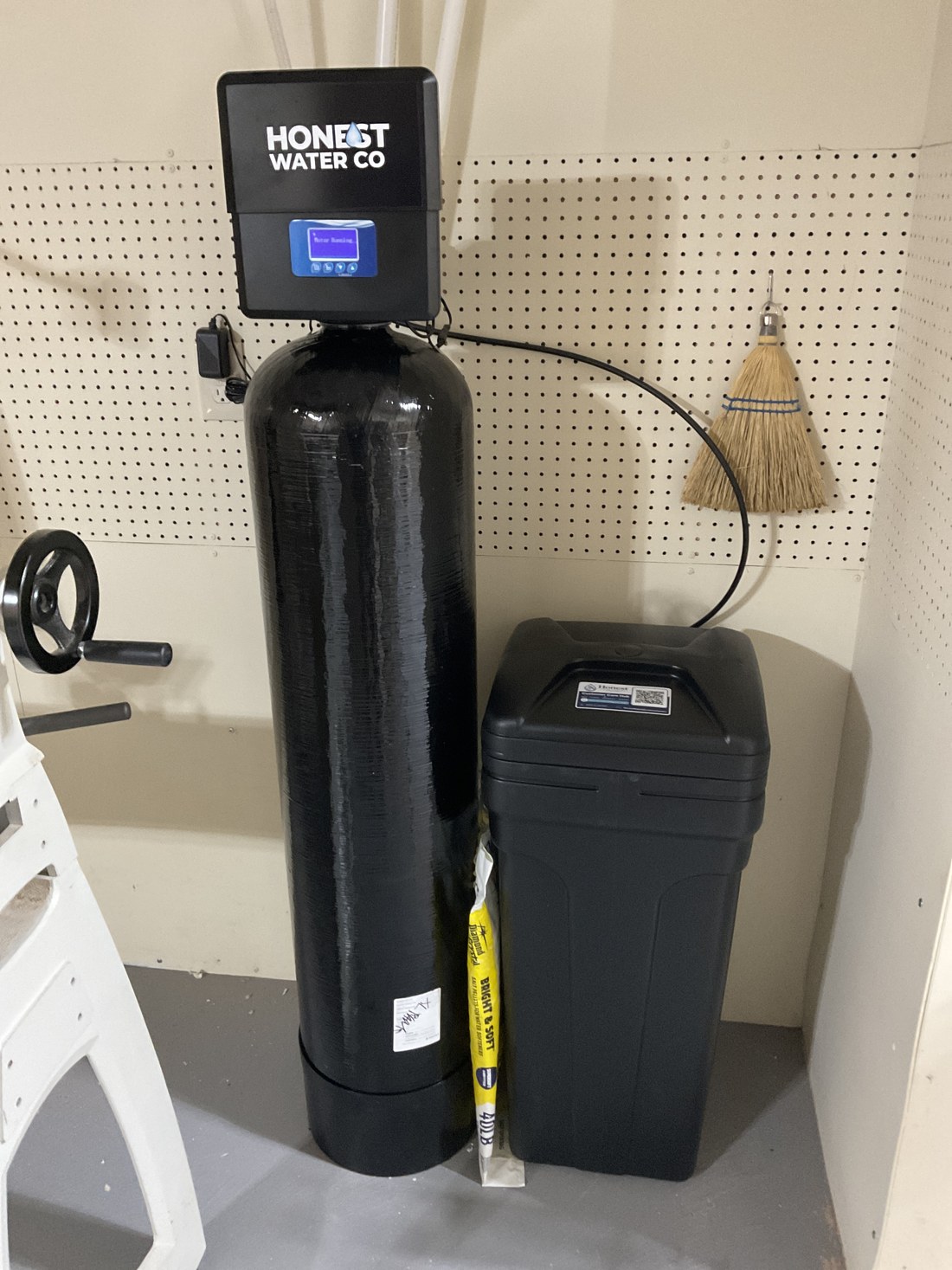 At the main line
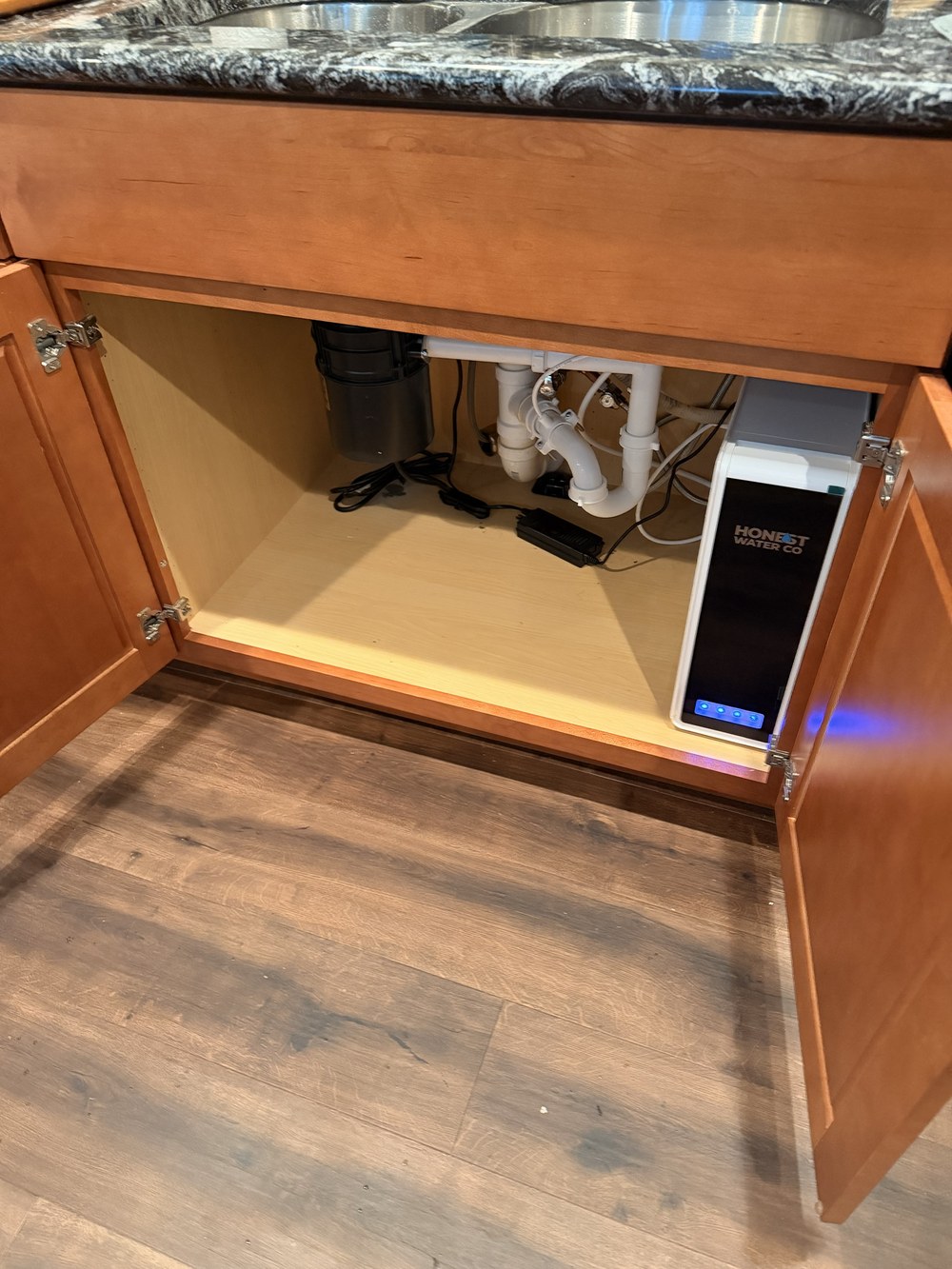
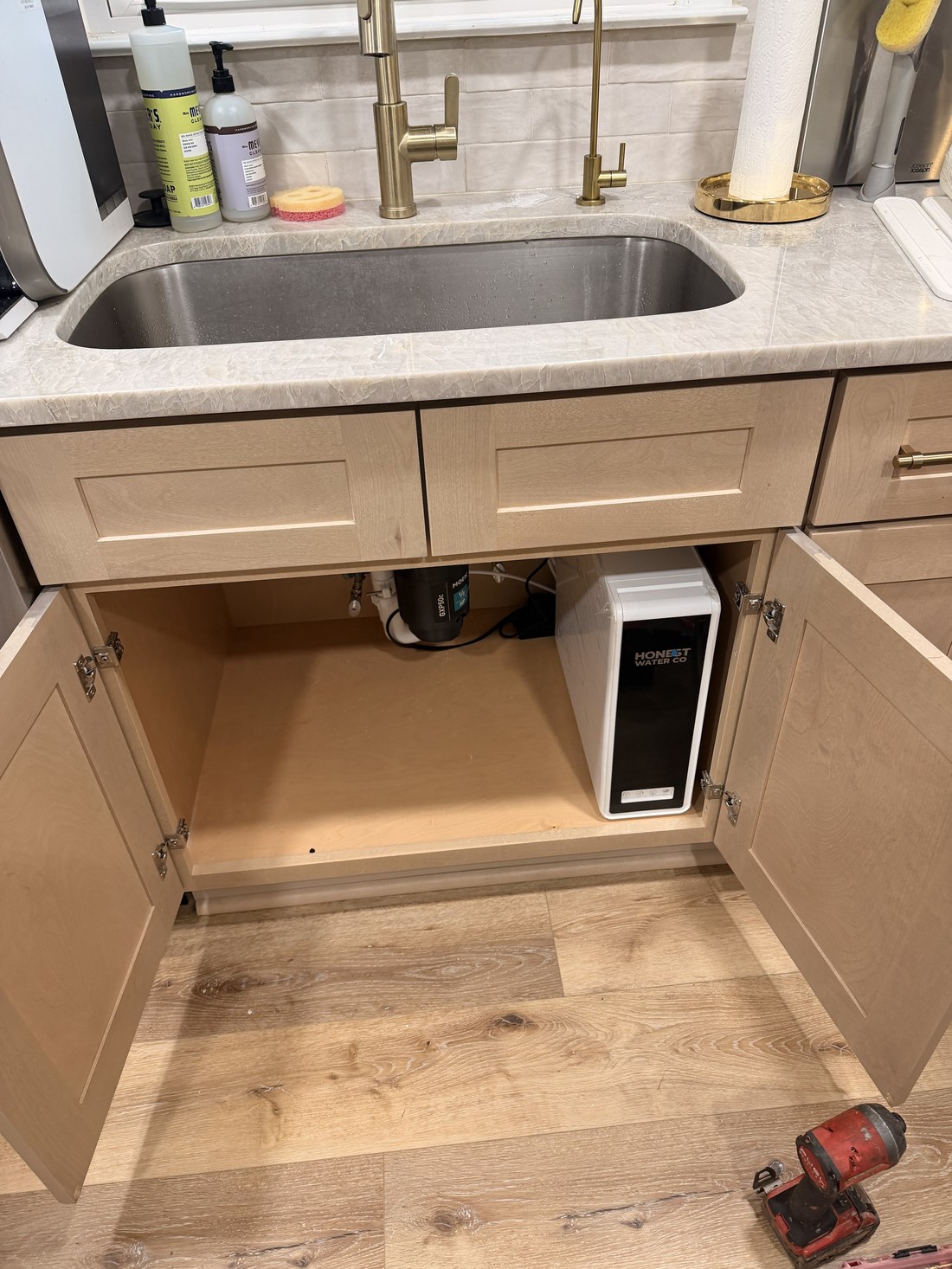 Under the kitchen sink
Illustration: the two treatment layers in a standard Honest Water installation.
That gives you two distinct layers:
- Treat the water entering the entire house.
- Give drinking and cooking water a final RO filtration step.
Simple.
But there's another North Georgia water problem this solves at the same time.
The Stuff You Can Actually See
Forget invisible contaminants for a second.
Look at your shower door. Your faucets. Your dishes. The inside of your coffee maker.
That white crusty residue? That's largely the mineral content associated with hard water.
It's why your shower glass never seems clean. Soap doesn't behave the way you expect. Fixtures develop scale. Glasses come out spotted. And mineral buildup accumulates anywhere water gets heated.
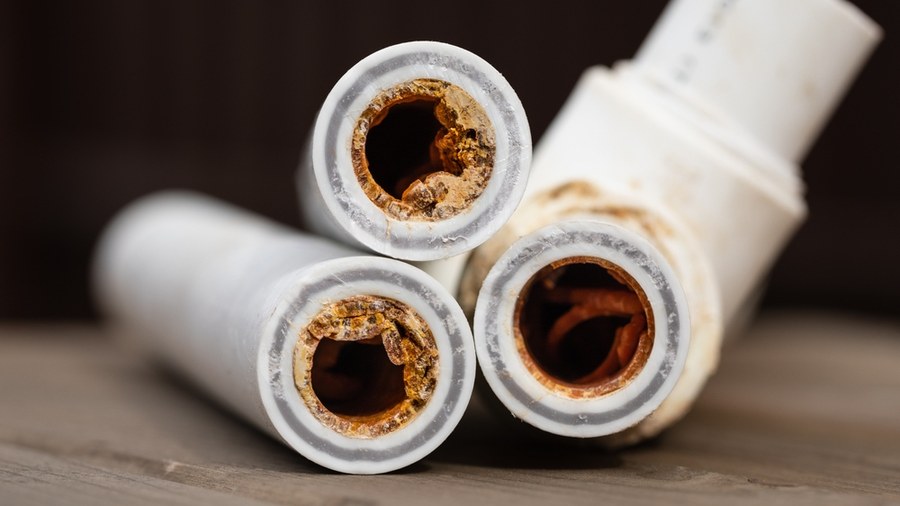
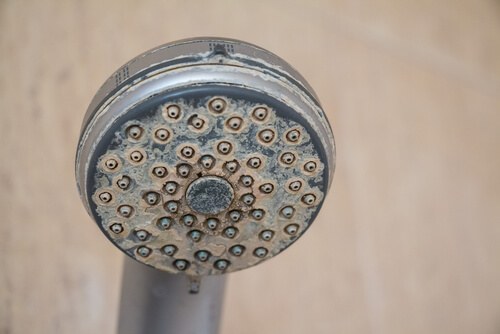
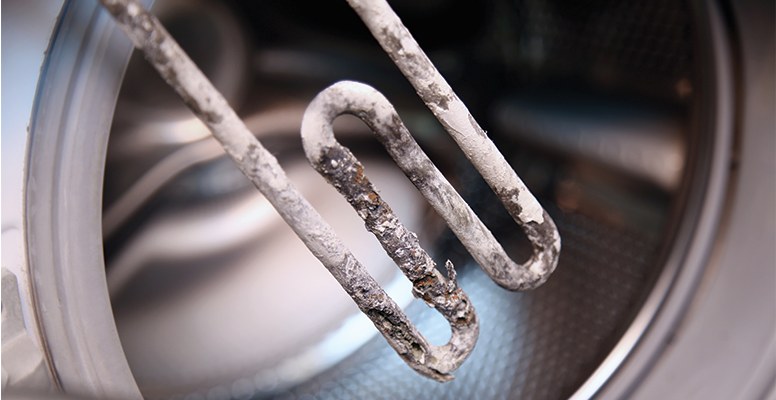
So alongside activated carbon filtration, the system uses ion-exchange resin to address hardness minerals.
In other words: the carbon handles the stuff you're worried about. The softener handles the stuff you're already annoyed by. Then RO gives you the high-quality drinking water at the kitchen sink.
See What This Would Cost For My Home →Takes about a minute. No one comes to your house just to give you a price.
At This Point We Thought We Had The Answer. There Was Only One Problem.
Everybody Wanted $8,000-$12,000 For It.
That's when this entire story took another weird turn.
Once we knew what we wanted installed, we did what homeowners normally do: started getting quotes.
And that's where we discovered another North Georgia water problem. Not with the water. With the industry.
A traditional water-treatment quote often goes something like this:
Someone comes to your house. Tests your water at the kitchen table. Starts showing you what's supposedly wrong. Then begins a two-hour presentation.
Eventually, an $8,000, $10,000 or even $12,000 number appears.
You hesitate.
The salesperson suddenly remembers a promotion. Or needs to “call his manager.”
Five minutes later, several thousand dollars mysteriously disappears.
If you've ever bought windows, roofing, HVAC or water treatment this way... you know exactly what we're talking about.
Susan Said It Better Than We Can
Susan isn't our customer. She had already purchased a comparable system elsewhere before she ever found us.
Her price? More than $9,000.
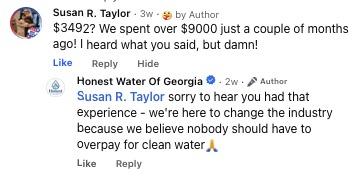
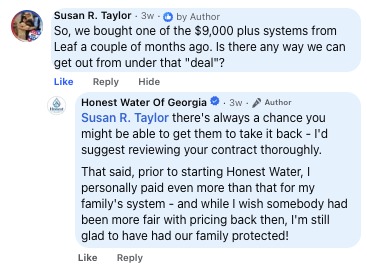
Over $9,000. For a comparable category of system.
And she wasn't alone.
And an actual Honest Water customer said he'd received two quotes around $8,000 before finding us.
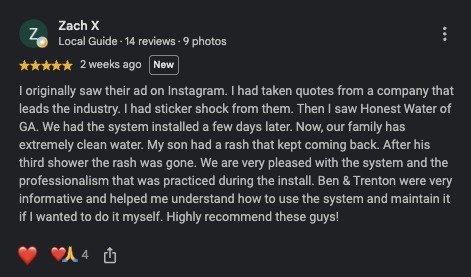
Another called the competing quote he received from an industry leader “sticker shock.”
Here's the thing: the equipment didn't suddenly become three times cheaper when it reached our warehouse.
The difference was the business model. Sales commission. Marketing. Corporate and franchise overhead. The cost of every appointment that doesn't close. The long in-home sales process.
Then I Became The Customer This Industry Is Built Around
Before Honest Water existed, I did exactly what most homeowners do. I scheduled the “free water test.”
A salesperson came to our house. He tested the water at our kitchen table.
Then came the presentation. And the presentation. And more presentation.
The demonstrations. The scary-looking test results. The explanation of everything supposedly wrong with our water. The giant price reveal.
Then, when I hesitated, the price started moving. Suddenly there were discounts. Special offers. Numbers that apparently weren't available five minutes earlier.
If you've ever sat through a traditional in-home water treatment pitch, you probably know exactly what I'm talking about.
Eventually... I bought the system.
And I paid way too much for it.
But here's the part you might not expect:
I don't regret buying it. Not even a little.
Because at the end of the day, I wanted better water for my family. We drink it. We cook with it. We shower in it. We wash our clothes and dishes in it.
And having water in our home that I felt good about was absolutely worth paying for.
What I regret is how much of my money had nothing to do with getting better water.
Once I learned how the traditional water-treatment business actually works, the price suddenly made sense.
A huge portion of what I had paid wasn't sitting in my mechanical room filtering water. It was paying for the machine required to sell me the system in the first place.
- Sales commissions
- Marketing costs
- Corporate overhead
- The salesperson driving to my house
- The hours he spent at our kitchen table
- And all the appointments just like mine where somebody sat through the entire presentation and didn't buy anything
Based on the economics I later came to understand, roughly 60% of what I paid was supporting that sales-and-overhead machine rather than the equipment itself.
Roughly where my money actually went
Sales commission, marketing, overhead, the cost of appointments that never close
The actual equipment and installation
Estimate based on the industry economics I came to understand after buying my own system.
And that bothered me.
Not because I thought families shouldn't invest in their water. I had just done exactly that, and I'd do it again.
It bothered me because I couldn't understand why getting great water for your family had to mean paying for an enormous sales organization along with it.

So We Built The Water Company We Wished Had Existed When I Was Shopping
That became the idea behind Honest Water of Georgia.
Not: “How cheaply can we build a water system?”
How good of a system can we build if we stop making the customer pay for everything that has nothing to do with their water?
So that's what we did.
We removed the expensive in-home sales model. No commissioned closer spending three hours on your couch. No theatrical kitchen-table water test required before we'll tell you the price. No inflated starting number so we have room to “discount” it. No calling the manager. No wondering whether your neighbor somehow negotiated a better deal than you did.
Instead, we put the money into the part that actually stays at your house:
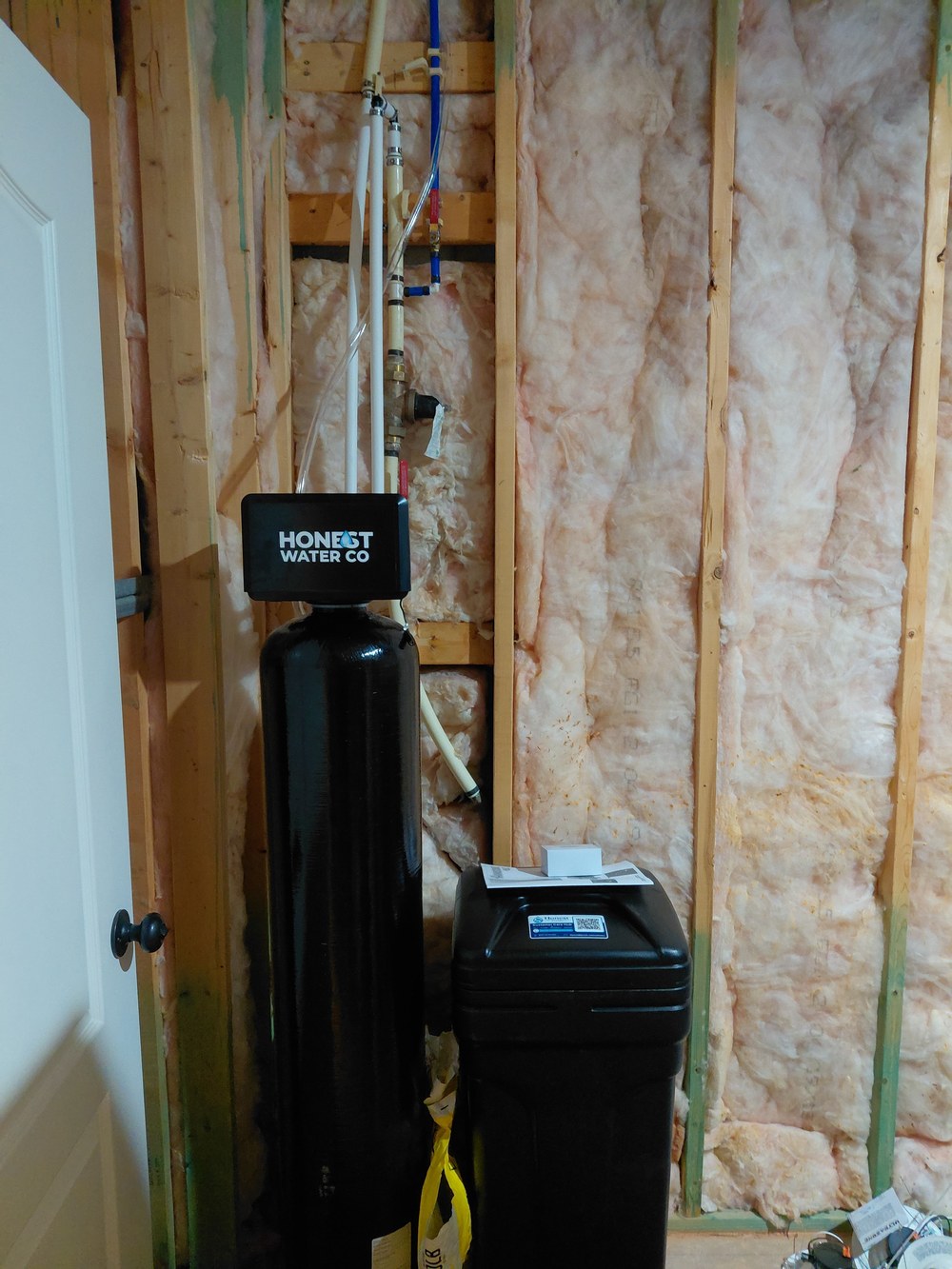
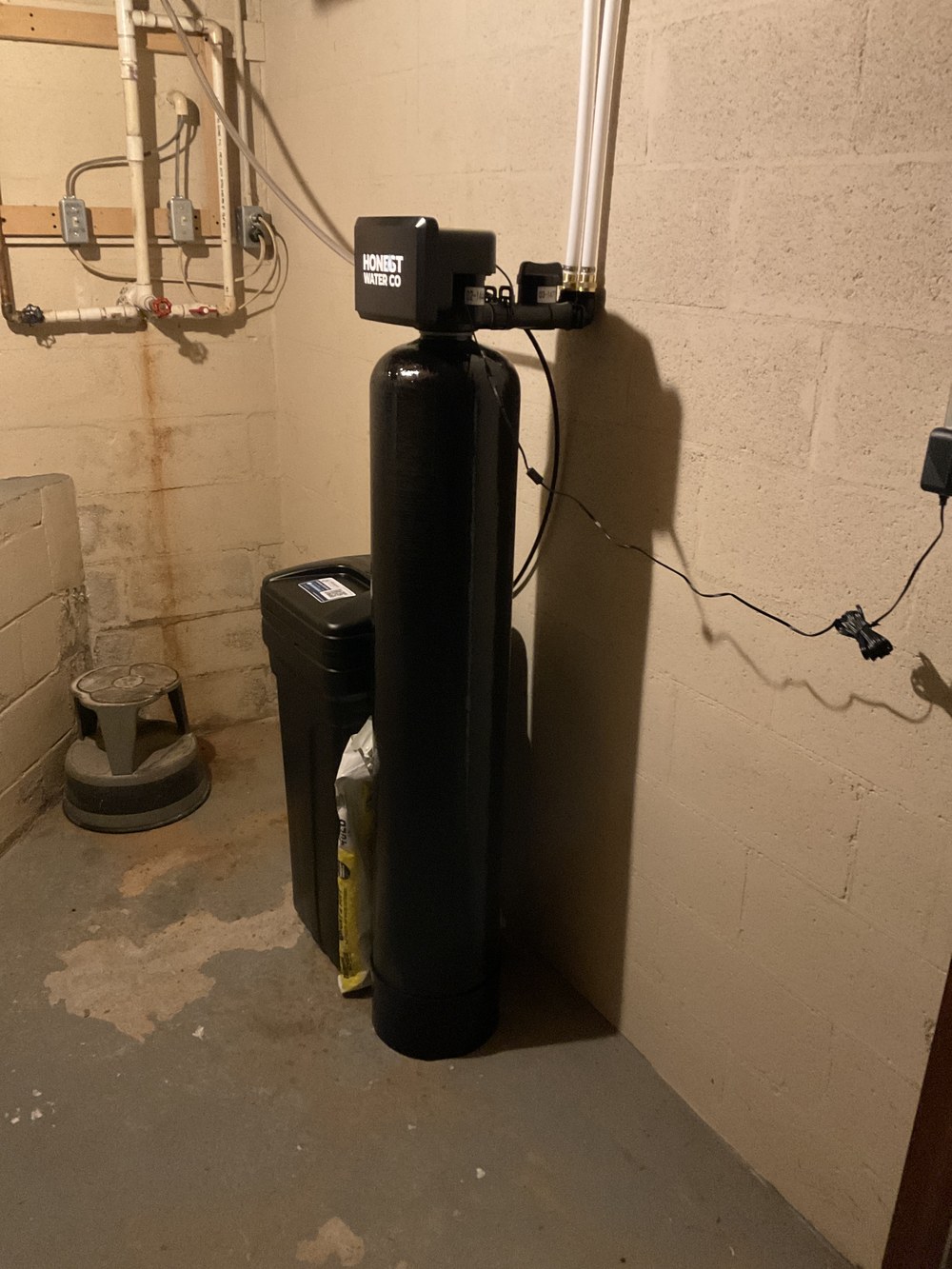
- Pentair tanks
- Hankscraft control valves
- Jacobi coconut-shell activated carbon
- ResinTech ion-exchange resin
- A tankless reverse-osmosis system for drinking and cooking water
- Professional installation
We cut the sales model. Not the equipment.
The only thing we removed was the guy on your couch.
So Here Is The Price. In Public.
Comparable traditional quotes frequently reported to us by our customers:
UPDATE: This price holds while the current round of North Georgia install slots lasts
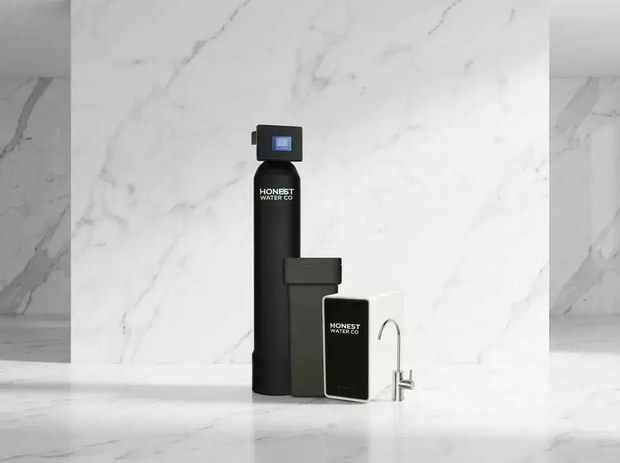
Whole-home filtration and softening, plus tankless RO
The Complete Home Water System, Installed
North Georgia's honest water filtration company
Quotes our customers report receiving: $8,000 to $12,000+
$3,492
Fully installed
0% same-as-cash for up to 24 months*
or payments as low as $79/month*
For qualified customers, $0 down. The $79 a month figure is a separate payment plan on this $3,492 system, not the 0% offer.
or payments as low as $79/month*
For qualified customers, $0 down. The $79 a month figure is a separate payment plan on this $3,492 system, not the 0% offer.
- Whole-home carbon filtration
- Ion-exchange water softening
- Tankless RO drinking system
- Professional installation
- Lifetime System Warranty
- Monthly payment options available to qualified homeowners
What the problem already costs you
$2,000+per year, every year
Bottled water, disposable filters, countertop gadgets - one faucet at a time, and most of the house still untreated.
vs
To actually solve it
$79/mo as low as, on this $3,492 system, for qualified customers*
Whole-home filtration, softening and RO drinking water. One system, every faucet in the house.
Better equipment. Less overhead. No in-home sales theater.
Quote range reflects competing quotes customers have reported to us, not a survey of every provider. *Payment options are offered through Wisetack and provided by its lending partners, subject to approval. Qualified customers can be offered 0% same-as-cash with terms up to 24 months. The $79 a month figure is a separate lower-payment option on this $3,492 system - it is not the 0% offer and is not $79 over 24 months. Your APR, term and payment are set at approval.
Grant Eilertson, co-founder, Honest Water of Georgia. Video not playing? Watch it on YouTube.
Get Georgia's Best Price →Takes about a minute. No one comes to your house just to give you a price.
And Apparently We Weren't The Only Ones Looking For That
Since then, North Georgia homeowners have been telling us essentially the same story over and over. They wanted better water. They hated the traditional sales process. And they couldn't understand why it was supposed to cost nearly $10,000.

Hunter Hensley
Google review
I had two other companies provide quotes in the range of $8,000. Honest Water surprised me with a shockingly low $3,495 for the system and installation... All-in-all Honest Water's prices were over 50% cheaper than their competitors, were extremely consultative through the whole process and were able to provide service roughly 450% more rapidly than their counterparts.

Zach X
Google review
I originally saw their ad on Instagram. I had taken quotes from a company that leads the industry. I had sticker shock from them. Then I saw Honest Water of GA. We had the system installed a few days later.

Bart Lewis
Google review
After doing my research on water softeners and companies providing these products, we chose to go with Honest Water. They were responsive and very forthright with what we needed and the total cost. No upselling or gimmicks to scare us on how \u201Ccontaminated\u201D our water was.
That's the niche we decided to own. Not the cheapest possible equipment. Not fear. Not miracle claims.
Good equipment. Straight answers. One fair price.
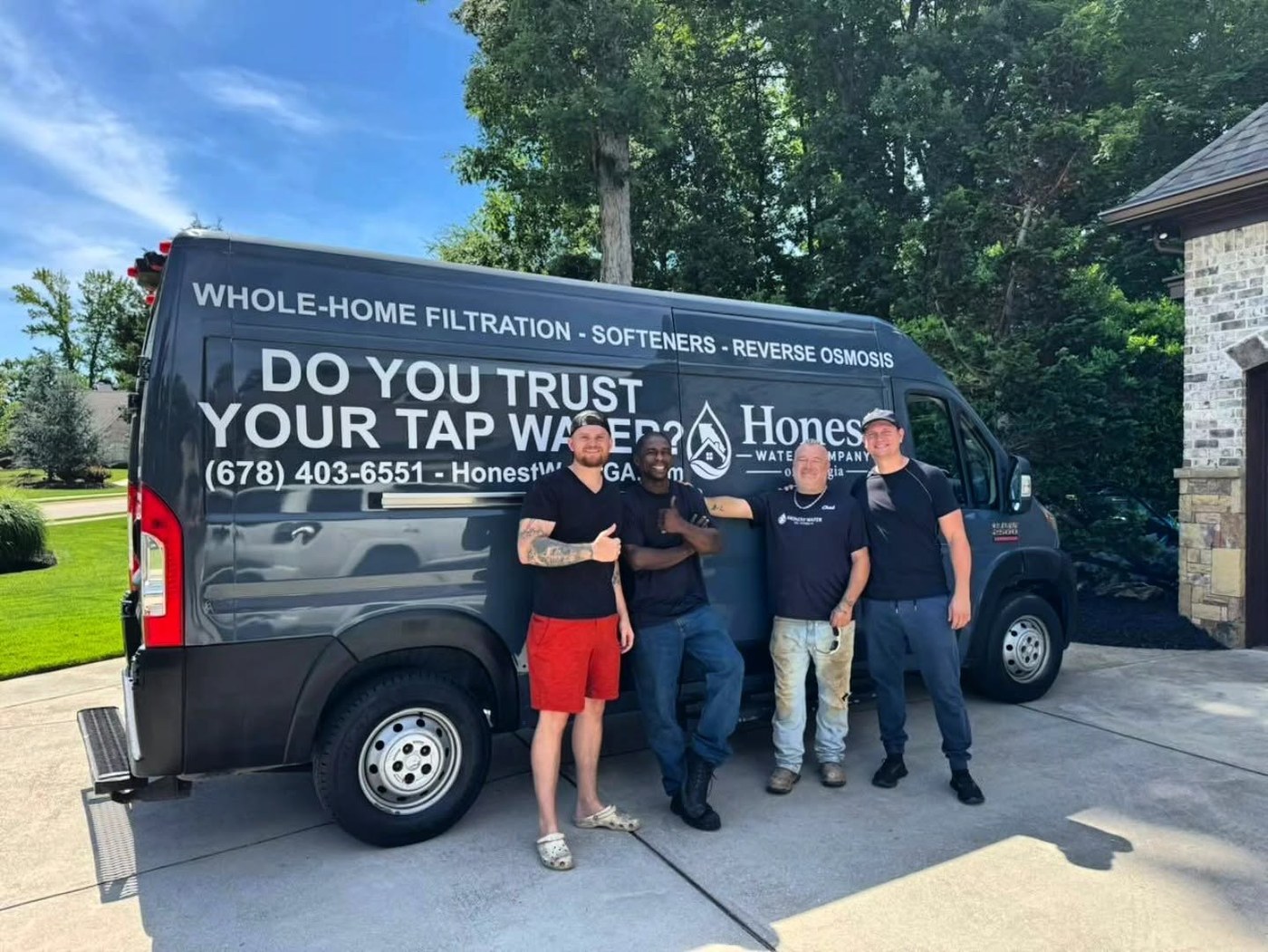
Here's Exactly What Happens If You Want It
No three-hour appointment. No obligation. No salesperson coming to your house just to give you a number.
- Talk to usRoughly a five-minute call. We confirm your location, home and water situation.
- Get your exact price$3,492 installed for the standard North Georgia city-water package. No in-home sales presentation.
- We install itFiltration and softening at the main water line, RO at the kitchen sink. Normally one visit.
- Turn on a faucetWhole-home treated water, plus dedicated RO drinking water in the kitchen.
So Here's The Question
You were drinking the same water ten minutes ago that you were before you opened this page.
Nothing suddenly changed.
The only thing that changed is: now you know what the numbers mean.
A result can be hundreds of times above an independent health guideline and still remain below a federal legal limit.
Nobody has to be lying. Nobody has to be breaking the law.
Your utility can be doing its job. The water can be compliant.
And you can still decide:
“That's not the standard I want for my house.”
You don't need to panic. You don't need to stop showering. You don't need to start hauling 40 bottles of water home from Costco every week.
But ask yourself honestly:
- How many more cases of bottled water will you carry in from the car?
- How many more pitcher and fridge cartridges will you buy for the one faucet they cover?
- How many more years of scale will your water heater, dishwasher and coffee maker absorb?
- Or are you ready to turn on any faucet in the house and trust what comes out?
You just have to decide what you want the water coming through your pipes to look like.
Because the treatment plant controls the water until it enters the distribution system.
You control what happens when it reaches your house.
Is “legally compliant” the standard you want for your family... or just the minimum standard your water company is required to meet?
Get Georgia's Best Price →$3,492 fully installed. Financing available for qualified homeowners.
A Few Straight Answers Before You Go
“Are you saying North Georgia tap water is unsafe?”
No. We're showing you publicly available water-quality data and the difference between federal legal limits and independent health guidelines. What standard you choose for your own home is up to you.
“Does the system remove everything?”
No legitimate water-treatment company should promise that. Different filtration technologies reduce different substances at different rates. That's why we use whole-home carbon filtration together with softening and dedicated reverse osmosis for drinking water.
“Do I need someone to come test my city water before you can give me a price?”
Usually, no. For standard North Georgia city-water homes, we can normally determine what you need without putting you through an in-home sales presentation.
“What if I'm on a well?”
Well water is different. Your water isn't coming from a municipal treatment system, so we evaluate well-water homes separately and recommend treatment based on those conditions.
“Is $3,492 actually the installed price?”
Yes, for our standard city-water package. Whole-home filtration and softening plus the tankless RO drinking system, professionally installed.
“What's the catch?”
There isn't a three-hour sales presentation hidden behind the button. That's kind of the point.
Sources
Water-quality figures: EWG Tap Water Database, Braselton, GA (PWS GA1570000), utility-reported results 2021-2023, supplied in part by Jackson County Water & Sewer Authority. EWG health guidelines are independent benchmarks published by the Environmental Working Group and are not federal legal limits.
Federal drinking-water standards: U.S. EPA National Primary Drinking Water Regulations. PFAS limits finalized April 2024.
You don't need to trust us. Every number on this page links back to where it came from.
Water-quality figures: EWG Tap Water Database, Braselton, GA (PWS GA1570000), utility-reported results 2021-2023, supplied in part by Jackson County Water & Sewer Authority. EWG health guidelines are independent benchmarks published by the Environmental Working Group and are not federal legal limits.
Federal drinking-water standards: U.S. EPA National Primary Drinking Water Regulations. PFAS limits finalized April 2024.
You don't need to trust us. Every number on this page links back to where it came from.
Honest Water of Georgia · $3,492 installed · Local & family-owned · Serving North Georgia